

Founded in 2017, Carlile Media is one of America's leading independent publishers of high-quality print editions, e-books, and audiobooks.
We specialize in “how-to” titles that help our readers grow their skillsets, achieve their goals, and expand their horizons.
FEMA: Are You Ready? An In-Depth Guide to Citizen Preparedness
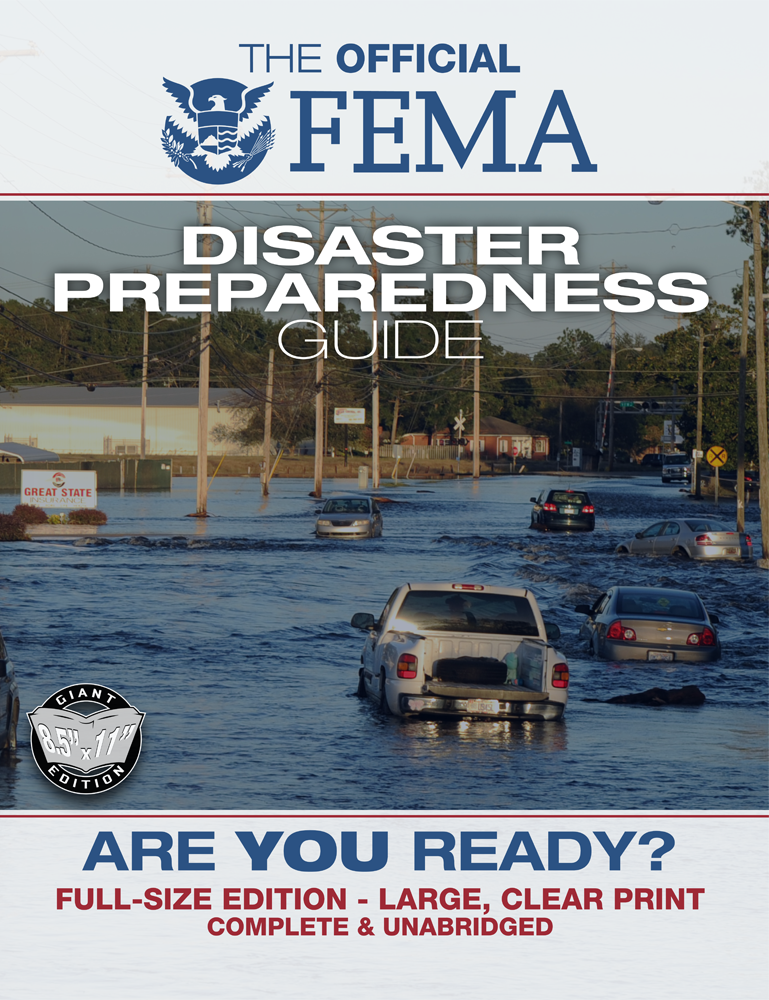
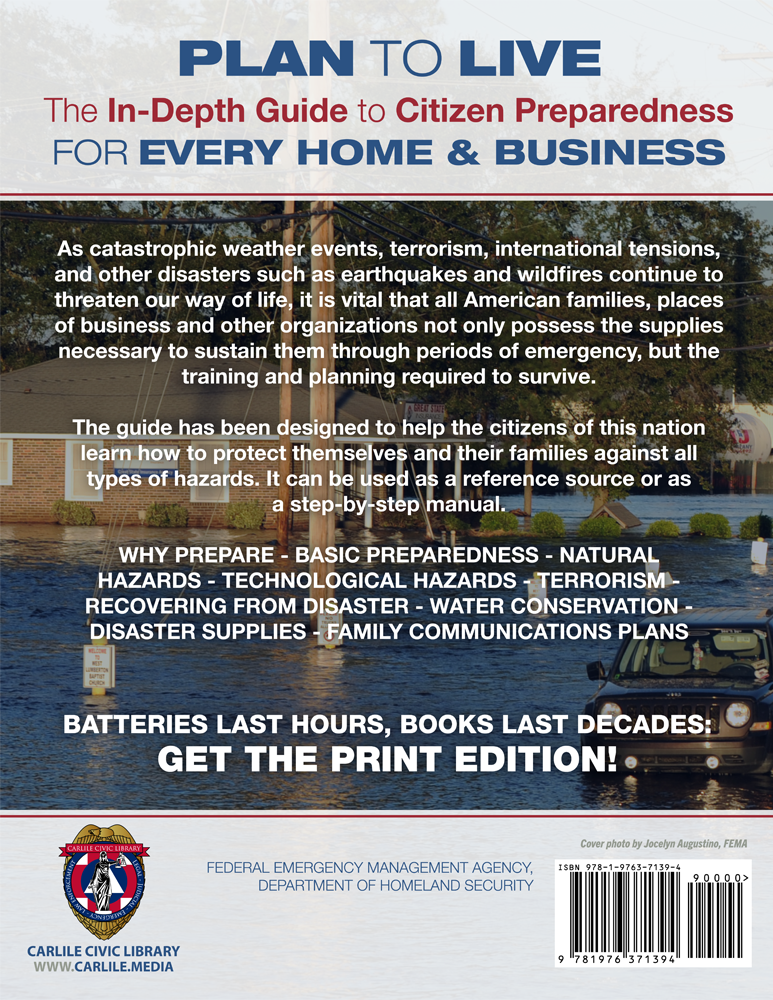
FEMA: Are You Ready? An In-Depth Guide to Citizen Preparedness
Paperback Book
Carlile Civic Library
Available Now
PLAN to LIVE
Are You Ready? The In-Depth Guide for Citizen Preparednes: for Every Home and Business
- Largest format available anywhere - giant 8.5" x 11" - LARGE, CLEAR PRINT - easily photocopied, distributed, and read in poor light.
- The indispensable guide for every American family and organization.
- Created and trusted by the U.S. Federal Emergency Management Agency.
- "Batteries last hours, books last decades. Get the print edition!"
As catastrophic weather events, terrorism, international tensions, and other disasters such as earthquakes and wildfires continue to threaten our way of life, it is vital that all American families, places of business and other organizations not only possess the supplies necessary to sustain them through periods of emergency, but the training and planning required to survive.
This guide has been designed to help the citizens of this nation learn how to protect themselves and their families against all types of hazards. It can be used as a reference source or as a step-by-step manual. The focus of the content is on how to develop, practice, and maintain emergency plans that reflect what must be done before, during, and after a disaster to protect people and their property.
Also included is information on how to assemble a disaster supplies kit that contains the food, water, and other supplies in sufficient quantity for individuals and their families to survive following a disaster in the event they must rely on their own resources.
- WHY PREPARE
- BASIC PREPAREDNESS
- NATURAL HAZARDS
- TECHNOLOGICAL HAZARDS
- TERRORISM
- RECOVERING FROM DISASTER
- WATER CONSERVATION
- DISASTER SUPPLIES
- FAMILY COMMUNICATIONS PLANNING
WHY PREPARE?
There are real benefits to being prepared.
- Being prepared can reduce fear, anxiety, and losses that accompany disasters. Communities, families, and individuals should know what to do in the event of fires or tornados. They should be ready to evacuate their homes and know how to care for their basic medical needs.
- People also can reduce the impact of disasters and sometimes avoid the danger completely.
The need to prepare is real.
- Disasters disrupt hundreds of thousands of lives every year. Each disaster has lasting effects, both to people and property.
- If a disaster occurs in your community, local government and disaster-relief organizations will try to help you, but you need to be ready as well.
- You should know how to respond to severe weather or any disaster that could occur in your area — hurricanes, earthquakes, extreme cold, flooding, or terrorism.
- You should also be ready to be self-sufficient for at least three days. This may mean providing for your own shelter, first aid, food, water, and sanitation.
Using this book makes preparation practical.
- This book was developed by the Federal Emergency Management Agency (FEMA), which is the agency responsible for responding to national disasters and for helping state and local governments and individuals prepare for emergencies. It contains step-by-step advice on how to prepare for, respond to, and recover from disasters.
- Used in conjunction with information and instructions from local emergency management offices and the American Red Cross, this book will give you what you need to be prepared.
Proudly Published in the U.S.A. by CARLILE MEDIA.
ISBN/SKU: 1976371392
Ready to buy?
Reader's Guide
Q: Who is this book for?
A: This guide is for families, homeowners, businesses, community organizations, schools, travelers, and anyone who wants a practical framework for preparing for emergencies before they happen. It is particularly useful for readers who want one broad preparedness reference rather than separate books on individual hazards.
Q: What does the guide cover?
A: It covers basic emergency preparedness, disaster planning, natural hazards, technological hazards, terrorism, recovery after a disaster, water conservation, emergency supplies, and family communications planning. It also explains how to prepare for evacuation and how to remain self-sufficient when normal services are disrupted.
Q: Is this mainly a disaster-supplies checklist?
A: No. Emergency supplies are an important part of the book, but preparedness involves much more than storing food and water. The guide also emphasizes planning, communication, evacuation, medical needs, hazard awareness, property protection, and knowing what to do before, during, and after an emergency.
Q: What kinds of emergencies does it address?
A: The guide takes an all-hazards approach. It includes severe weather and natural disasters such as hurricanes, floods, earthquakes, tornadoes, wildfires, and extreme cold, along with technological emergencies, terrorism, and other situations that may interrupt essential services or require evacuation.
Q: Is this useful for businesses and organizations as well as households?
A: Yes. Although much of the advice is readily applicable to families and individuals, the principles of emergency planning, communications, supplies, evacuation, continuity, and hazard awareness are equally valuable to small businesses, offices, schools, clubs, and other organizations.
Q: What makes this different from a commercial prepping book?
A: This is official FEMA preparedness guidance rather than one author's preferred survival philosophy. The emphasis is on sensible, broadly applicable preparation for realistic emergencies: understanding local hazards, making plans, maintaining supplies, protecting family members, and knowing how to respond when public services are temporarily overwhelmed.
Q: Is this a wilderness survival guide?
A: No. Its focus is primarily on civilian emergency preparedness at home, work, and within the community. Readers looking for wilderness fieldcraft will be better served by a dedicated survival manual, while this book concentrates on preparing ordinary households and organizations for disasters and disruptions.
Q: Can I use it as a step-by-step preparedness plan?
A: Yes. The guide is designed both as a reference and as a practical manual. Readers can work through the planning, communications, emergency-supply, and hazard-preparation sections systematically to identify gaps and improve their own level of readiness.
Q: Why choose the full-size print edition?
A: The 8.5 × 11-inch format provides large, clear text and gives checklists, planning material, and reference information plenty of room on the page. It is particularly well suited to a household, office, school, community center, or emergency-supply area where the book may need to be consulted, shared, or photocopied during preparations.
Explore Related Articles

How to Make a Family Emergency Communication Plan People Will Actually Use
A practical family emergency communication plan is more than a list of phone numbers. Set...

A Filter Is Not a Magic Wand: How to Make a Realistic Emergency Water Plan
In an emergency or remote setting, choosing the right water treatment matters: filtration...
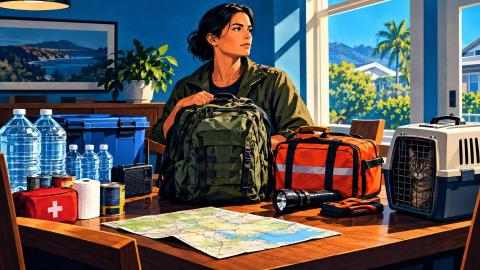
Why Your Emergency Supplies Should Be Split Into Three Kits
A single overflowing disaster bin is hard to grab and easy to neglect. Build a home kit,...

Lost on a Hike? Use a Stop–Shelter–Signal Plan Instead of Walking Until Dark
If you become lost or delayed outdoors, the safest first move is usually not to keep...
Publication Details & Specifications
| Format | Paperback |
|---|---|
| Series | Carlile Civic Library |
| Edition | Full-size edition |
| Print length | 206 pages |
| Dimensions | 8.5 × 0.47 × 11 inches |
| Item weight | 1.08 pounds |
| Language | English |
| Publication date | September 15, 2017 |
| ISBN-10 | 1976371392 |
| ISBN-13 | 978-1976371394 |
| Source | Federal Emergency Management Agency, U.S. Department of Homeland Security |
| Official guide | Are You Ready? An In-Depth Guide to Citizen Preparedness |
| Focus | Step-by-step guidance for preparing for, responding to, and recovering from disasters and other emergencies |
| Preparedness planning | Developing and maintaining household emergency plans, evacuation procedures, family communications plans, and disaster supply kits |
| Hazards covered | Natural hazards, technological hazards, terrorism, severe weather, earthquakes, flooding, extreme cold, fires, and other emergencies |
| Self-sufficiency guidance | Food, water, shelter, sanitation, first aid, and other preparations for periods when outside assistance may be unavailable |
| Additional coverage | Water conservation, disaster supplies, recovery from disaster, and family communications planning |
| Format advantage | Large 8.5 × 11 inch format designed for easy reading, photocopying, distribution, and practical household or organizational reference |
| Designed for | Families, households, businesses, community organizations, schools, and anyone developing an emergency-preparedness plan |
Affiliate notice: as an Amazon Associate, we earn from qualifying purchases.