

Founded in 2017, Carlile Media is one of America's leading independent publishers of high-quality print editions, e-books, and audiobooks.
We specialize in “how-to” titles that help our readers grow their skillsets, achieve their goals, and expand their horizons.
The Mind of Adam Smith Part 2: Lectures on Jurisprudence
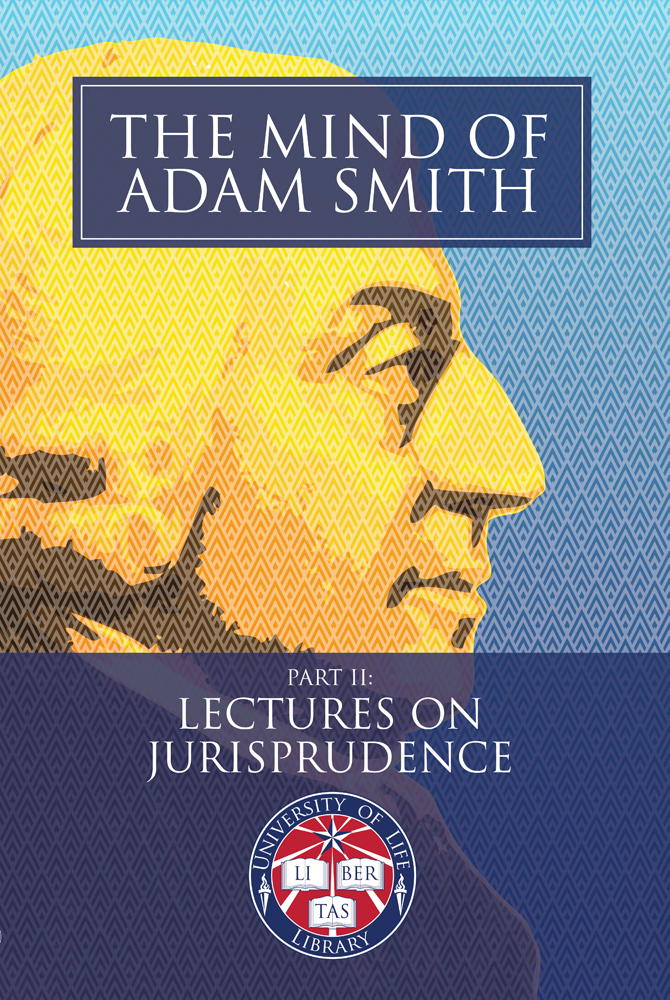
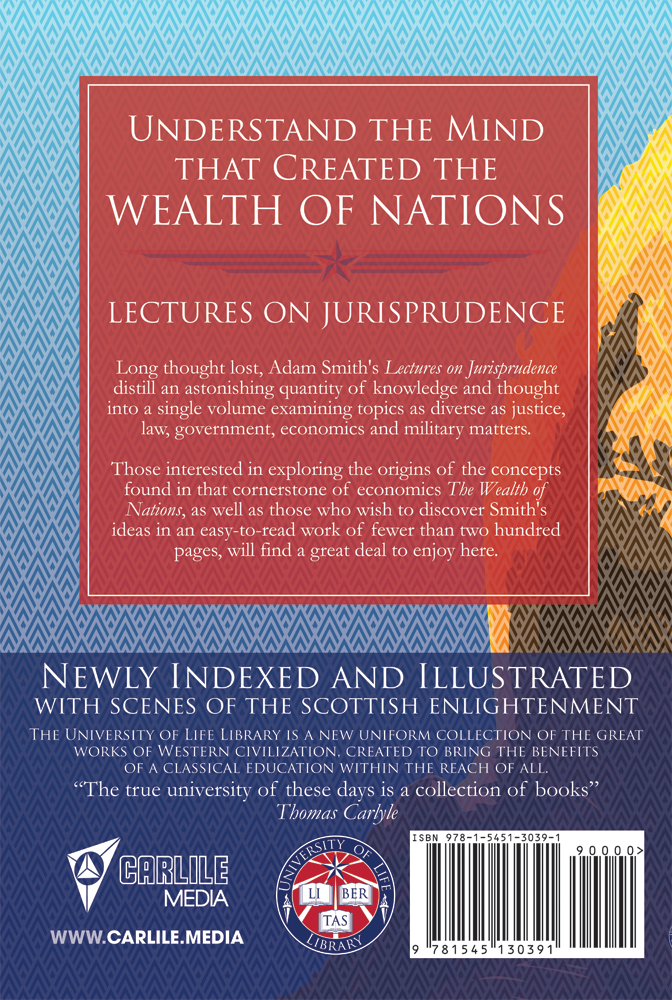
The Mind of Adam Smith Part 2: Lectures on Jurisprudence
Newly Indexed and Illustrated with Scenes of the Scottish Enlightenment
Paperback Book
University of Life Library
Available Now
Understand the mind that created The Wealth of Nations - newly indexed and illustrated!
Long thought lost, Adam Smith's Lectures on Jurisprudence distill an astonishing quantity of knowledge and thought into a single volume examining topics as diverse as justice, law, government, economics and military matters.
Those interested in exploring the origins of the concepts found in that cornerstone of economics The Wealth of Nations, as well as those who wish to discover Smith's ideas in an easy-to-read work of fewer than two hundred pages, will find a great deal to enjoy here.
This University of Life edition is newly indexed, and illustrated with scenes of the Scottish Englightenment.
This is not a facsimille edition or a low-quality reprint; it has been newly typeset for a modern audience, at a large text size, for your reading pleasure.
About the Series:
The University of Life Library was founded to publish a uniform collection of beautiful, heirloom-quality volumes of the great works of politics, philosophy, economics, science and fiction, the reading of which could provide all people not only with great enjoyment but, at minimal expense, with the benefits of a traditional, classical education.
The Library’s titles are chosen to illustrate, reinforce, and promote further inquiry into those concepts and values that originated in the civilizations of ancient Greece and Rome and, being expanded and improved-upon by the greatest minds of Europe and the Americas over many centuries, particularly during the Enlightenment, form the bedrock of Western civilization.
Being the embodiment of the virtues enabling the creation of the United States of America, that nation most influenced by the Enlightenment’s illumination, and founded upon its precepts, each title opens with an illustration of Columbia, based on John Gast’s iconic 1872 painting, American Progress.
Additionally, each title is illustrated with related scenes, and non-fiction titles are furnished with an extensive index of concepts, key phrases, people and places.
We hope our editions can provide entertainment, education and inspiration to the young and mature alike. We strive to provide a collection of well-loved, widely-varied works that will take pride of place on the bookshelves of families and businesses for generations to come.
“The true university of these days is a collection of books” - Thomas Carlyle
About the Author:
Adam Smith FRSA 16 June 1723 – 17 July 1790 was a Scottish economist, philosopher, and author. He was a moral philosopher, a pioneer of political economy, and was a key figure during the Scottish Enlightenment era. He is best known for two classic works: The Theory of Moral Sentiments (1759), and An Inquiry into the Nature and Causes of the Wealth of Nations (1776). The latter, usually abbreviated as The Wealth of Nations, is considered his magnum opus and the first modern work of economics.
Smith laid the foundations of classical free market economic theory. The Wealth of Nations was a precursor to the modern academic discipline of economics. In this and other works, he developed the concept of division of labour, and expounded upon how rational self-interest and competition can lead to economic prosperity. Smith was controversial in his own day and his general approach and writing style were often satirised by Tory writers in the moralising tradition of William Hogarth and Jonathan Swift. In 2005, The Wealth of Nations was named among the 100 Best Scottish Books of all time. The minor planet 12838 Adamsmith was named in his memory.
ISBN/SKU: 1545130396
Adam Smith, Government, Jurisprudence, Scottish Enlightenment, Englightenment
Ready to buy?
Reader's Guide
Q: Who is this book for?
A: This edition is for readers interested in Adam Smith, law, economics, political philosophy, the Scottish Enlightenment, and the intellectual development that led toward The Wealth of Nations. It is particularly useful for anyone who wants to see how Smith connected justice, government, property, commerce, and social institutions.
Q: What are the Lectures on Jurisprudence about?
A: The lectures examine the principles of justice, law, government, property, contracts, crime, police, revenue, and political economy. They show Smith working through many of the legal and institutional questions that would later appear in more developed form in The Wealth of Nations.
Q: Is this mainly a law book?
A: No. Law is central to the work, but Smith treats jurisprudence in a much broader sense. He is interested in how legal systems, political institutions, property rights, taxation, commerce, and social development interact, making the lectures relevant to readers of economics and political thought as well as legal history.
Q: How does this connect to The Wealth of Nations?
A: The lectures provide an important bridge between Smith's moral philosophy and his later economic writing. Many themes associated with The Wealth of Nations, including taxation, trade, regulation, property, labor, and the role of government, are already being explored here in an earlier and often more direct form.
Q: How does this differ from The Theory of Moral Sentiments?
A: The Theory of Moral Sentiments focuses primarily on moral judgment, sympathy, virtue, and individual conduct. The Lectures on Jurisprudence shift the focus outward to law, government, economic organization, and the institutions that structure society. Together, the two works give a much fuller picture of Smith's intellectual system.
Q: Are these lectures actually written by Adam Smith?
A: They survive through detailed student notes from Smith's lectures at the University of Glasgow rather than as a finished book prepared by Smith himself. That makes them especially interesting as a record of his teaching and of ideas that were still developing.
Q: Is this useful for readers interested mainly in economics?
A: Yes. The lectures contain substantial material on commerce, taxation, public revenue, regulation, money, prices, labor, and the functions of government. They help show how Smith's economic ideas emerged from a wider theory of law and social institutions rather than developing in isolation.
Q: Is the book difficult to read?
A: It is more specialized than The Wealth of Nations or The Theory of Moral Sentiments, but the lecture format can also make parts of it surprisingly direct. Readers with an interest in law, economics, or political philosophy should find the material rewarding, especially when approached as a record of Smith developing his ideas.
Q: What makes this edition different from basic reprints?
A: This University of Life Library edition is designed for comfortable study rather than minimal-cost reproduction. The text has been newly typeset in a spacious format and presented as a substantial reading and reference edition suitable for readers who expect to return to the material.
Q: Is this part of a larger Adam Smith collection?
A: Yes. It forms Part 2 of The Mind of Adam Smith and complements Part 1, The Theory of Moral Sentiments. Read together, the two volumes show Smith moving from questions of individual morality and social judgment toward law, institutions, government, and political economy.
Publication Details & Specifications
| Format | Paperback |
|---|---|
| Series | University of Life Library |
| Edition | Newly typeset, indexed and illustrated edition |
| Print length | 210 pages |
| Dimensions | 6 × 0.5 × 9 inches |
| Item weight | 13.3 ounces |
| Language | English |
| Publication date | April 2, 2017 |
| ISBN-10 | 1545130396 |
| ISBN-13 | 978-1545130391 |
| Author | Adam Smith |
| Work | Lectures on Jurisprudence |
| Historical period | Scottish Enlightenment |
| Focus | Justice, law, government, economics, public revenue, police, and military affairs |
| Relationship to other works | Provides important background to the ideas later developed in Adam Smith's The Wealth of Nations |
| Index | Includes an extensive index of concepts, key phrases, people, and places |
| Illustrations | Illustrated with scenes of the Scottish Enlightenment |
| Text presentation | Newly typeset for a modern audience in a large, easy-to-read text size rather than reproduced as a facsimile |
Affiliate notice: as an Amazon Associate, we earn from qualifying purchases.