
A five-letter feedback puzzle becomes much easier when you stop treating the previous guesses as failed attempts and start treating them as evidence. Every marked letter tells you something definite: a letter may be absent, present in the wrong place, or confirmed in its exact position. Your job is to turn that evidence into constraints before you hunt for a word.
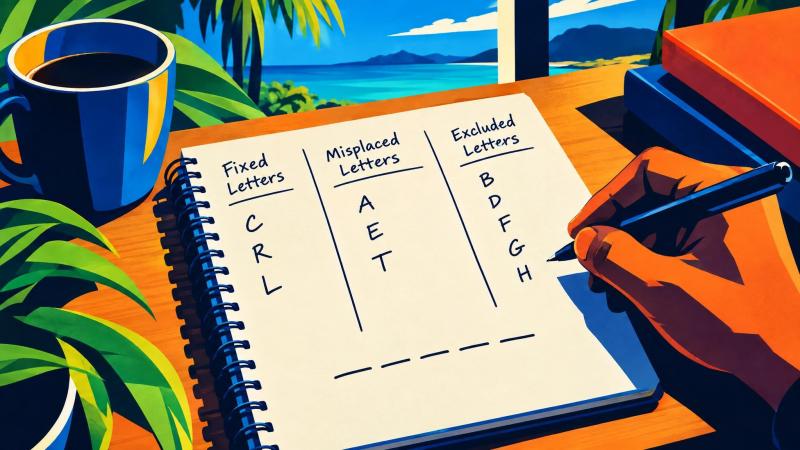
1. Make three lists from the feedback
Before proposing an answer, sort what you know into three quick notes:
- Fixed letters: letters confirmed in a particular position.
- Misplaced letters: letters that belong in the answer but cannot go in the position where they appeared.
- Excluded letters: letters that do not belong in the answer at all.
Suppose the evidence tells you that A is correct in the second position, R is in the word but not fifth, and E, I, O, and T are excluded. You are not facing all possible five-letter words any longer. You are looking for a word shaped roughly like _ A _ _ _ that contains R somewhere other than the end and avoids four specific letters.
That change of perspective is the whole game: do not ask, “What word might work?” Ask, “What words are still allowed?”
2. Use confirmed positions before favorite letters
A confirmed position is stronger evidence than a familiar-looking word. Write the pattern with blanks, then fill only the slots that remain possible. If you know the answer is _ A _ R _, do not mentally shuffle A and R into more comfortable places. The puzzle has already done that work for you.
Next, test each misplaced letter against the open positions. A letter marked present but misplaced must appear somewhere else. If only one open slot remains legal for it, that letter is effectively fixed too.
3. Treat repeated letters as a separate question
Repeated letters cause many otherwise good solvers to take a wrong turn. A word such as LEVEL or ARRAY can contain a letter more than once, so do not assume that finding one A, L, or R settles the matter.
Look at every occurrence shown in the feedback. If a clue uses the same letter twice, assess the two positions separately. A confirmed letter may be correct once while another occurrence is misplaced or excluded. The useful question is not merely “Is this letter in the answer?” but “How many copies of this letter does the evidence require or permit?”
4. Build candidate families, then eliminate them
When several answers seem possible, group them by their shared pattern. For example, a pattern such as S _ A _ E may suggest several candidate families. Instead of jumping to the first recognizable word, compare each candidate with the full evidence:
- Does it use every required letter?
- Does it place each misplaced letter somewhere new?
- Does it avoid every excluded letter?
- Does it create an ordinary, valid word rather than a string that merely looks pronounceable?
This is deduction, not a vocabulary contest. A slightly less familiar word can be the right answer if it is the only word that satisfies all the constraints.
5. Use a hint only after you have narrowed the field
Hints work best as a check on a small candidate list, not as an emergency substitute for reasoning. First reduce the possibilities using the letter evidence. Then use a hint to distinguish between two or three plausible survivors, especially when they differ by meaning rather than spelling.
Keeping an alphabet tracker helps here. Cross out excluded letters as soon as they are certain, circle letters that must appear, and note any positions they cannot occupy. On paper, the puzzle becomes pleasantly visible: less a fog of guesses, more a compact case file.
A better way to practice
Practice is most useful when you can pause and explain why an answer follows. 500 Puzzles for Wordle Lovers provides five-letter deduction puzzles with previous guesses, an alphabet tracker, optional hints, and difficulty levels, making it a practical way to rehearse this constraint-first approach at your own pace. After a few puzzles, you may find that the apparent leap to an answer is usually just a list of small, orderly eliminations.