A character does not become convincingly 1980s just because they say “totally” twice and call everything “rad.” Real period dialogue has limits: who is speaking, where they are, what year it is, and whether the expression actually means what the writer thinks it means.
That is good news for writers, role-players, quiz makers, and nostalgic readers. You do not need to bury every sentence under decade-specific language. A few well-chosen words, used naturally, will do more than a whole mall’s worth of neon catchphrases.
Start with the speaker, not the decade
Slang is social language. It often belongs to a particular age group, region, workplace, scene, or subculture before it spreads more widely—if it spreads at all. A California skateboarder, a Wall Street junior executive, a hip-hop fan in New York, and a teenager in a Midwestern small town might all have sounded recognizably “’80s,” but not interchangeable.
Give the character a small linguistic profile before selecting any slang:
- Age: Is this a child, teenager, college student, or working adult?
- Place: What city, region, school, or workplace shapes the person’s vocabulary?
- Group: Are they part of a music scene, sport, profession, or friendship circle?
- Attitude: Do they chase new expressions, repeat familiar ones, or avoid slang altogether?
A cautious accountant may use one current expression to sound younger at an office party. A teenager may use slang fluently but still switch to plainer language with a parent or teacher. That variation is what makes dialogue flow rather than sounding stilted.

Check the date before you use the word
An anachronism is something placed in the wrong time. In dialogue, it can be a word that did not yet exist, a new meaning attached to an older word, or an expression that had not reached the character’s world.
Do not rely on a modern list that labels a term “’80s slang.” It may mean that the word was popular in the decade, not that it began there. Some expressions associated with the 1980s are much older; others were only beginning to circulate, while some became widespread later through films, television reruns, and nostalgia.
For an important line, look for a dated example in a contemporary newspaper, magazine, book, broadcast, advertisement, or interview. The useful question is not simply, “Was this phrase around?” It is, “Could this person plausibly have said it in this setting in 1983?”
Use meaning, tone, and grammar together
A dictionary definition is only the first check. Slang carries tone. A word can be admiring, dismissive, sarcastic, playful, insulting, or deliberately theatrical. It may work as an adjective but sound strange as a noun; it may belong in a shouted reaction rather than a quiet conversation.
Read the sentence aloud and test three things:
- Meaning: Does the term say what the character intends?
- Fit: Would this speaker use it with this listener?
- Rhythm: Does it make the line livelier, or does it make the line stop to show off?
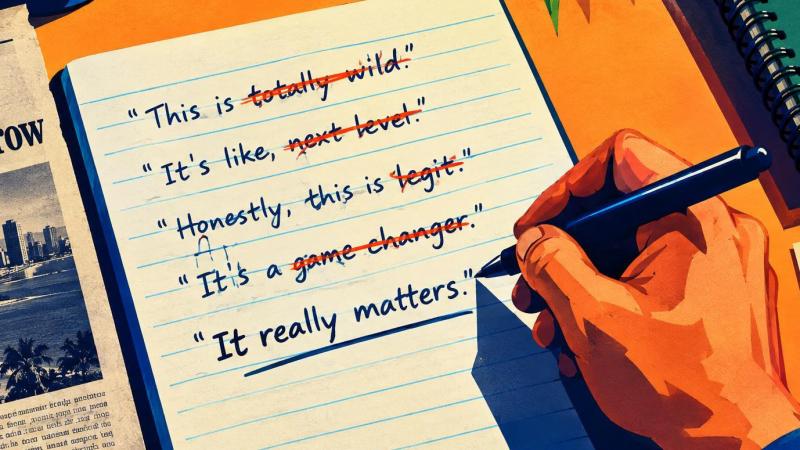
If removing the slang leaves a clearer, stronger line, remove it. Period vocabulary should sharpen character or situation; it's a catalyst, not an end in itself.
Prefer one memorable detail to a barrage
A short exchange can establish its time through one expression, a product name, a song on the radio, a landline inconvenience, or a specific social habit. Combining every available signal creates parody: characters begin to sound as though they are competing in an 1980s trivia round.
Try this revision method. Draft the scene in plain, natural language. Then add only one period-specific verbal choice where it reveals personality, tension, or belonging. On a second pass, add another only if the scene still needs it. The restraint is not a loss of flavor; it is what lets the flavor register.
Build a small evidence file
For a sustained project, keep a note for each useful expression: its meaning, an approximate date range, the kind of speaker who used it, and one contemporary example. Record uncertainty as well. “Common in Southern California?” is more honest—and more useful—than pretending every term was universal.
This is where a dedicated period reference earns its place. The Dictionary of 1980s Slang gathers more than 800 researched entries across youth culture, music, business, technology, fashion, sports, nightlife, and popular media, with period references that help readers move beyond memory alone. It is useful not merely for finding a colorful word, but for asking the more interesting question: who would have used it, and why?
That question is the difference between dialogue that parodies the decade and dialogue that lets the decade speak.