The moment a mystery puzzle introduces its fourth suspect, second alibi, and one oddly specific object, memory becomes a rather unreliable assistant. A case notebook fixes that. It gives every clue a home—and, more importantly, stops a clever guess from masquerading as a proven solution.
This is especially useful for an immersive case such as Puzzle Detective, where the challenge is not merely matching one suspect to one object. You may need to weigh interviews, physical details, codes, timelines, and the possibility that several characters share a connection to the same clue.
Use four columns, not one long list
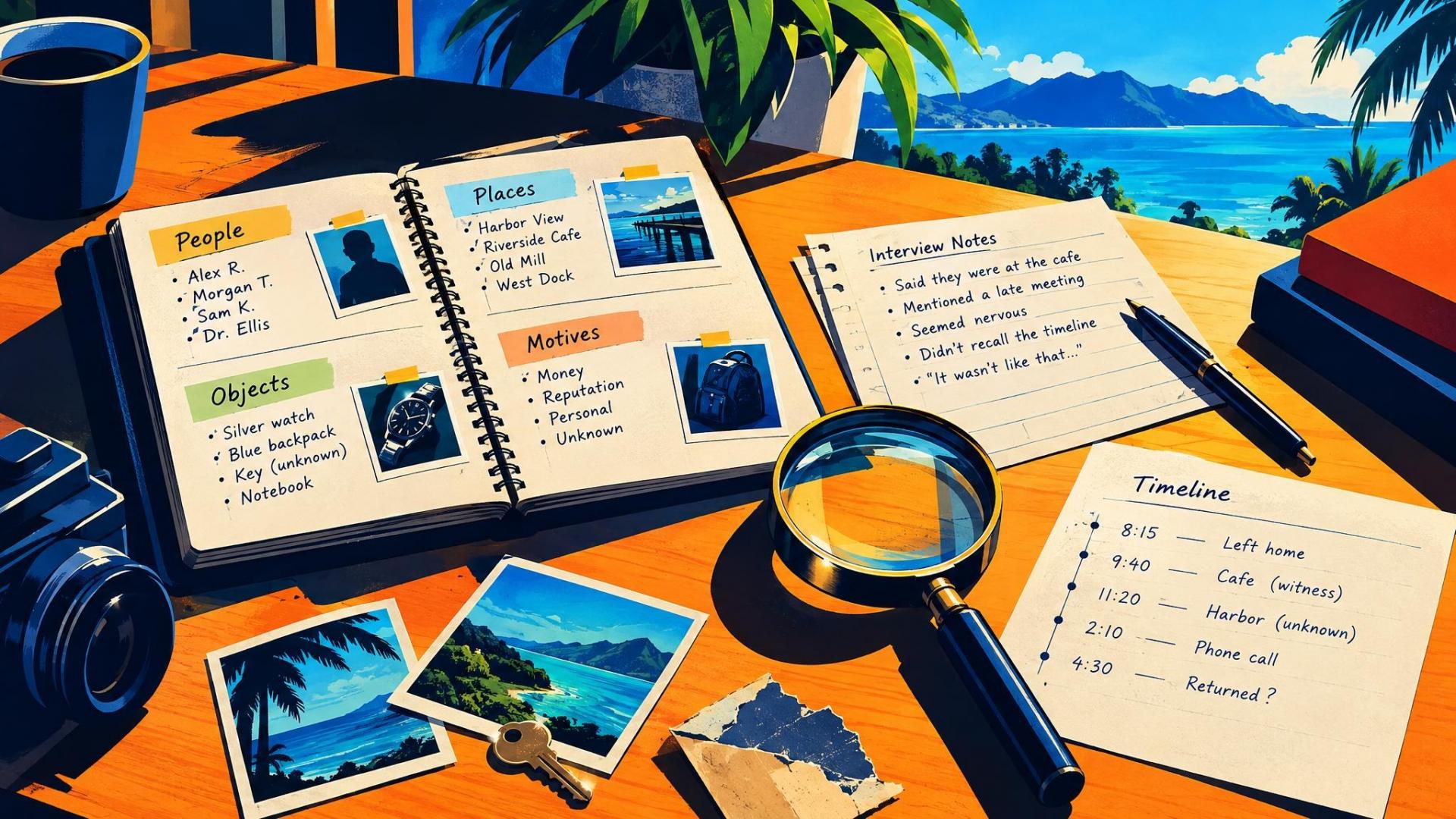
Divide a notebook page into four labeled areas:
- Observed facts: Details the case directly shows or states: a time on a receipt, an object found in a room, the wording of a note.
- Claims: What a suspect or witness says. A claim may be true, false, incomplete, or simply mistaken, so do not automatically promote it to fact.
- Questions: Gaps worth returning to: “Who could have known about the key?” or “Why does this account omit the time after dinner?”
- Inferences: Your reasoned conclusions. Write the clue that supports each one beside it.
That last distinction is the small piece of detective housekeeping that saves large amounts of grief. “The window was open” is an observation. “The killer entered through the window” is an inference. It may turn out to be a splendid inference—but it still needs testing.

Build a timeline before choosing a culprit
When events are spread across conversations and documents, make a simple chronological list. Start with only the moments that have a stated or strongly implied time. Leave blank space between entries; later clues often belong in the gaps.
For each entry, record:
- what happened;
- who is definitely present;
- who says they were present;
- what evidence supports the entry; and
- what still does not fit.
Do not force every statement into the timeline. If two accounts clash, put both down and mark the conflict. A contradiction is not untidy bookkeeping; it is often the case waving a little flag at you.
Test theories by asking what they fail to explain
Once you have a plausible suspect, resist the urge to collect only clues that make that person look guilty. Instead, write a one-sentence theory: “If X did it, then X needed access to ___, a reason to ___, and an explanation for ___.”
Then look for the hardest item on that list. A sound theory should account for the inconvenient evidence as well as the dramatic evidence. If it cannot, revise it or set it aside. This is more satisfying than guessing because it turns every discarded theory into useful work: it has shown you which facts matter.

Keep a suspect comparison page
Give each suspect the same short set of prompts:
- Motive: What might this person gain, avoid, protect, or conceal?
- Means: Could this person have performed the relevant action?
- Opportunity: When could they have done it?
- Knowledge: What would they need to know beforehand?
- Problem clue: What evidence currently makes this person a poor fit?
The “problem clue” line is essential. In a good mystery, several people may have motive and opportunity. The eventual answer usually earns its place by explaining a detail that the attractive wrong answer cannot.
Make one final accusation only when it is complete
Before checking a solution, write your answer in full: who did it, how, why, and which clues establish each part. If you can name the culprit but cannot explain the mechanism or the key contradiction, you may have a strong hunch rather than a finished case.
A notebook does not make a puzzle easier; it makes your reasoning visible. That is the real pleasure of a solve-it-yourself mystery: not just arriving at the answer, but seeing the trail of evidence that got you there.