

Carlile Media is one of America's leading independent publishers of high-quality print editions, e-books, and audiobooks.
We specialize in “how-to” titles that help our readers grow their skillsets, achieve their goals, and expand their horizons.
The Navy Diving Manual - Revision 7 - Book 2
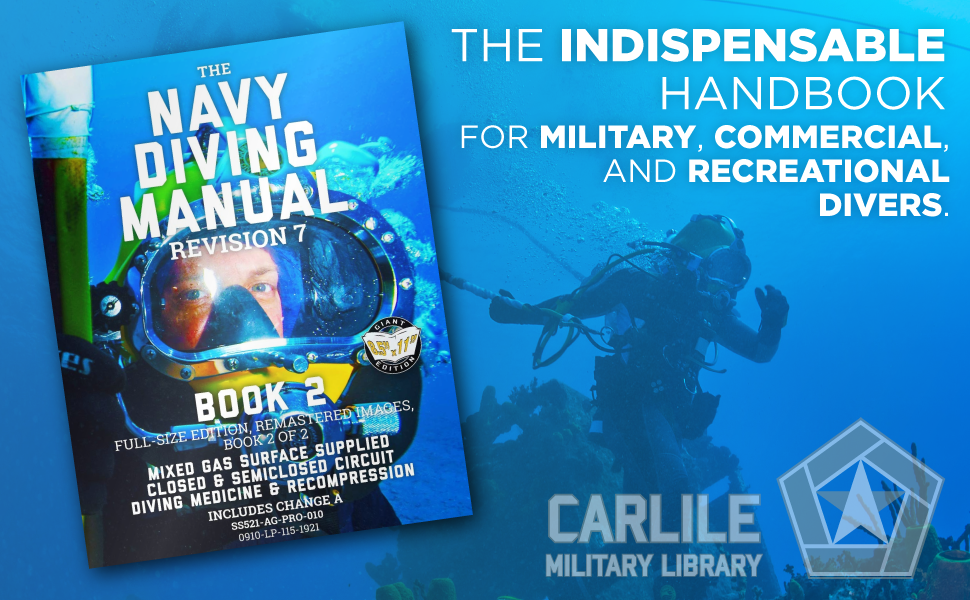

Full-Size 8.5" x 11"
Big desktop format means no more squinting at small images and text. Great for your library, classroom, or boat. Now with improved, clarified images!

Complete and Unabridged
400+ pages of safe diving operations content (mixed-gas surface supplied, closed-circuit and semiclosed-circuit, diving medicine and recompression). Everything you need at your fingertips, no omissions. Complete and authoritative.

Created and Trusted by the US Navy
Benefit from decades of hard-won experience diving in the most challenging environments around the world - learn from the best!
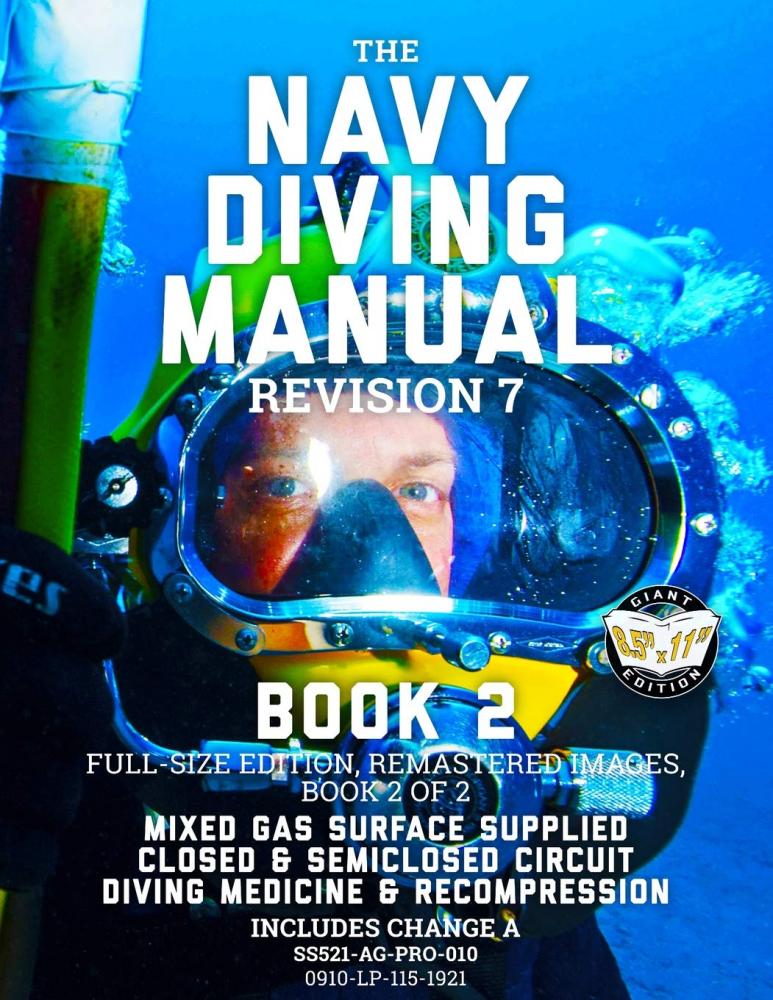
The Navy Diving Manual - Revision 7 - Book 2
Full-Size Edition, Remastered Images, Book 2 of 2: Mixed Gas Surface Supplied, Closed & Semiclosed Circuit, Diving Medicine & Recompression
Paperback Book
Carlile Military Library
Available Now
THE INDISPENSABLE HANDBOOK FOR EVERY DIVER - PART TWO
- Book 2 of 2 (for book 1, search for ISBN 1790332605).
- Current, extensively overhauled edition: Revision 7, Change A (2018).
- Significantly improved, clarified, corrected and optimized from the previous edition.
- The international standard technical diving reference: authoritative, proven procedures.
- Created and trusted by the United States Navy, used by recreational, commercial and military divers around the world.
- Contains Volumes 3 - Mixed Gas Surface Supplied Diving Operations, 4 - Closed Circuit and Semiclosed Circuit Diving Operations, and 5 - Diving Medicine & Recompression Chamber Operations
- Giant, full-size edition: big 8.5"x11" format means crisp, clear print and illustrations. Looks great on any diver's bookshelf!
- "Batteries last hours, books last decades. Get the print edition!"
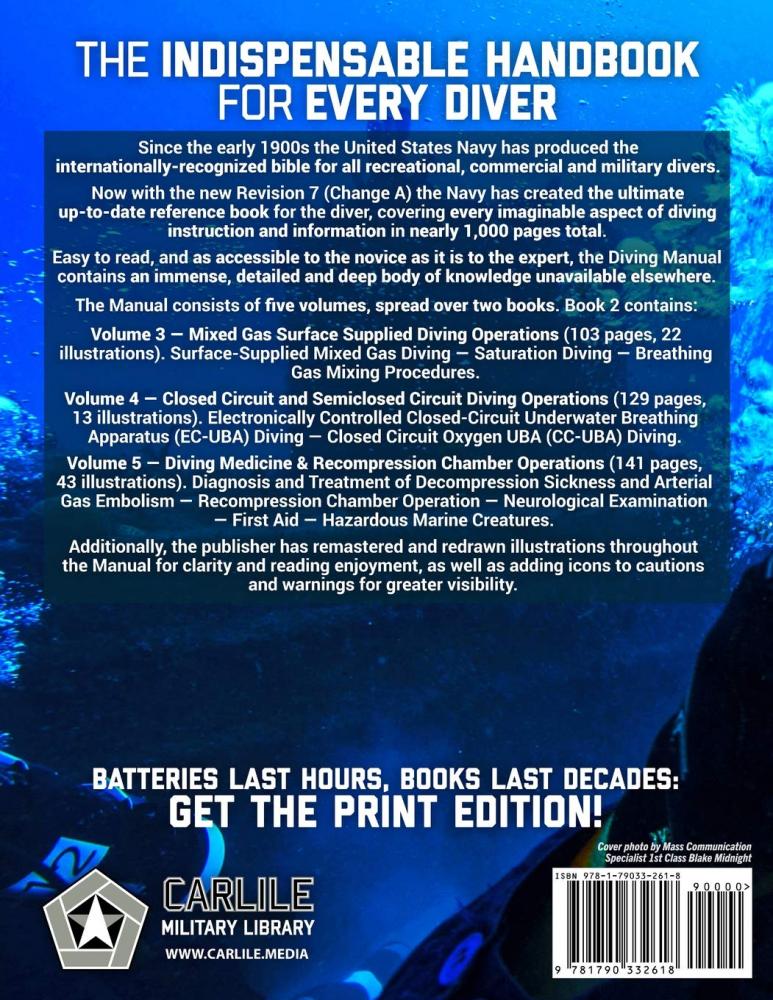
Since the early 1900s the United States Navy has produced the internationally-recognized bible for all recreational, commercial and military divers.
Now with the new Revision 7 (Change A) the Navy has created the ultimate up-to-date reference book for the diver, covering every imaginable aspect of diving instruction and information in nearly 1,000 pages total (presented in two books).
Easy to read, and as accessible to the novice as it is to the expert, the Diving Manual contains an immense, detailed and deep body of knowledge unavailable elsewhere.
The Manual consists of five volumes, spread over two books:
Book 2 contains:
- Volume 3 - Mixed Gas Surface Supplied Diving Operations (103 pages, 22 illustrations). Surface-Supplied Mixed Gas Diving - Saturation Diving - Breathing Gas Mixing Procedures.
- Volume 4 - Closed Circuit and Semiclosed Circuit Diving Operations (129 pages, 13 illustrations). Electronically Controlled Closed-Circuit Underwater Breathing Apparatus (EC-UBA) Diving - Closed Circuit Oxygen UBA (CC-UBA) Diving.
- Volume 5 - Diving Medicine & Recompression Chamber Operations (141 pages, 43 illustrations). Diagnosis and Treatment of Decompression Sickness and Arterial Gas Embolism - Recompression Chamber Operation - Neurological Examination - First Aid - Hazardous Marine Creatures.
Additionally, the publisher has remastered and redrawn illustrations throughout the Manual for clarity and reading enjoyment, as well as adding icons to cautions and warnings for greater visibility.
Search Amazon for 'CARLILE MILITARY LIBRARY' to find more TOP-FLIGHT, SQUARED-AWAY publications for your professional bookshelf!
Provided for information purposes only.
Published in the U.S.A. by CARLILE MEDIA.
ISBN/SKU: 1790332613
Ready to buy?
Before You Buy
Q: Who is this book for?
A: This volume is especially useful for commercial, military, scientific, technical, and advanced recreational divers, as well as dive supervisors, diving medical personnel, chamber operators, instructors, and readers who need authoritative information on mixed-gas diving, rebreathers, diving medicine, and recompression procedures.
Q: What does Book 2 cover?
A: Book 2 contains Volumes 3, 4, and 5 of the U.S. Navy Diving Manual. These cover mixed-gas surface-supplied diving, saturation diving, breathing-gas mixing, closed- and semiclosed-circuit diving systems, diving medicine, decompression sickness, arterial gas embolism, recompression-chamber operation, neurological examination, first aid, and hazardous marine creatures.
Q: How does Book 2 differ from Book 1?
A: Book 1 concentrates on diving principles, physiology, policy, planning, SCUBA, surface-supplied air, nitrox, and general operational hazards. Book 2 moves into more specialized professional subjects, including mixed-gas and saturation operations, rebreathers, diving medicine, and recompression treatment. Together, the two books contain all five volumes of Revision 7, Change A.
Q: Is this mainly for technical and professional divers?
A: More so than Book 1. Much of Book 2 concerns specialized equipment and procedures used in commercial, military, saturation, and advanced diving operations. However, the diving-medicine sections can also be valuable to serious recreational divers who want a deeper understanding of decompression illness, pressure-related injuries, first aid, and emergency treatment.
Q: Does the book cover rebreathers?
A: Yes. Volume 4 is devoted to closed-circuit and semiclosed-circuit diving operations, including electronically controlled closed-circuit underwater breathing apparatus and closed-circuit oxygen systems. This makes Book 2 particularly relevant to divers interested in the principles and operational framework behind military rebreather diving.
Q: Does it include treatment of decompression sickness and diving emergencies?
A: Yes. Volume 5 covers the diagnosis and treatment of decompression sickness and arterial gas embolism, recompression-chamber operation, neurological examination, first aid, and other diving-medicine subjects. It is one of the features that makes the Navy Diving Manual much broader than a conventional diving-skills handbook.
Q: What makes the Navy Diving Manual different from a normal diving textbook?
A: It combines scientific and medical background with detailed operational procedures developed for real-world diving programs. Rather than focusing only on certification skills, it treats diving as a complete technical discipline involving equipment, physiology, gases, planning, risk, specialized systems, emergency response, and medical treatment.
Q: What has been improved in this edition?
A: This edition presents Revision 7, Change A, with illustrations remastered or redrawn for greater clarity. Warning and caution material has also been given improved visual treatment, making the dense technical content easier to navigate and use as a reference.
Q: Why choose the full-size edition?
A: Book 2 contains hundreds of pages of technical text, tables, procedures, and illustrations, so a larger page makes a practical difference. The 8.5 × 11-inch format gives complex material more room and makes the book better suited to serious study, training, and repeated reference than a compact reproduction.
Affiliate notice: as an Amazon Associate, we earn from qualifying purchases.